Is a Mini Excavator Worth the Investment? A Complete Cost-Benefit Analysis
Due to the evolving needs of contractors, landscapers, and farmers who want a more efficient, nimble, and financially sensible way of working, the heavy machinery industry is witnessing a huge transformation. In fact, when you use the right mini excavator for executing small-scale construction projects or working in very constrained urban locations, it can either make or break your profitability.
For example, the traditional enormous excavators are operable only at great cost and they hamper the movement of the equipment in very confined spaces, so the compact machinery has gained popularity in the market. Our step-by-step guide will analyze and weigh if a mini excavator is a worthwhile business investment for you, including the initial expenditure, ongoing costs, and productivity benefits in real and concrete terms.
Purchasing heavy machinery is an important investment decision. The rapidly changing economy and other factors are making it increasingly difficult for the engineering and construction industries that are dependent on such equipment.
Machinery Asia has been analyzing how optimizing the fleet in the field of regional contracting improves the bottom line, and the data always shows compact machinery with high utilization. Based on the breakdown of the structural expenses and their juxtaposition with the daily operational advantages, we have developed a comprehensive cost-benefit analysis to assist you in deciding if a mini excavator fits your organizational roadmap.
Examining the Financial Composition of a Mini Excavator
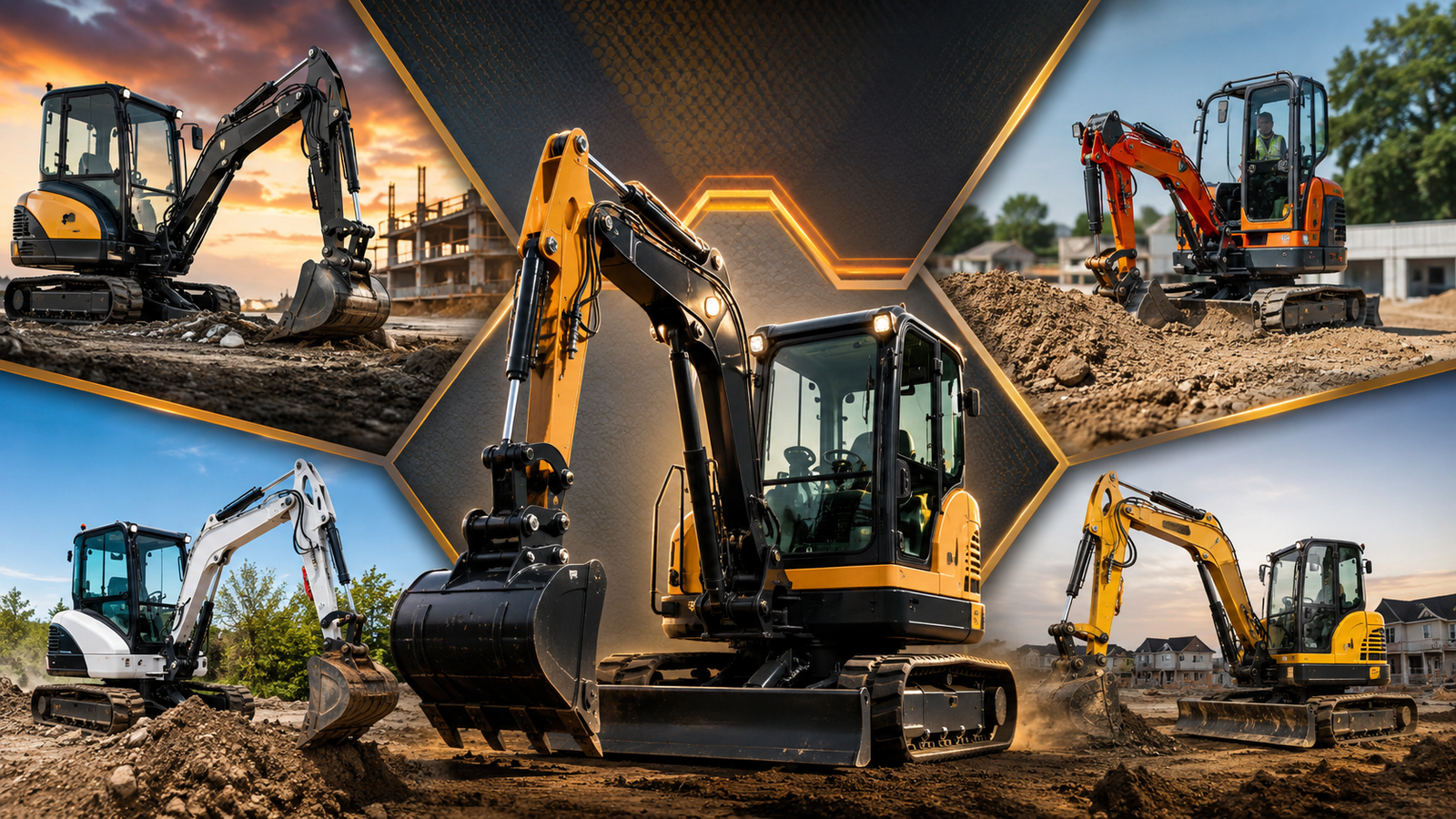
Prior to assessing the capability of the machines in terms of performance, you need to first identify major capital expenditures and ongoing costs that determine ownership. Mini excavators usually indicate any track or wheeled excavation machine whose operating weight is less than 10 metric tons.
In fact, they often have an engineering design similar to zero or reduced tail swing. Since these equipment need fewer materials to manufacture than regular full-sized excavators their market price entry-level is substantially lower and that is the reason for their popularity among growing businesses and independent contractors.
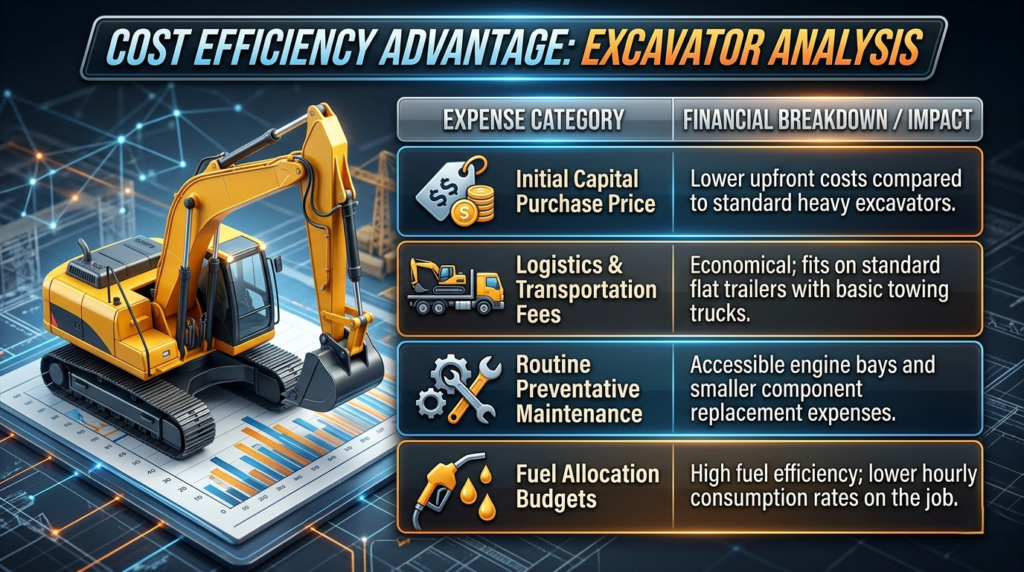
Table: Mini Excavators Financial Breakdown
| Expense Category | Financial Breakdown / Impact |
| Initial Capital Purchase Price | Lower upfront costs compared to standard heavy excavators. |
| Logistics & Transportation Fees | Economical; fits on standard flat trailers with basic towing trucks. |
| Routine Preventative Maintenance | Accessible engine bays and smaller component replacement expenses. |
| Fuel Allocation Budgets | High fuel efficiency; lower hourly consumption rates on the job. |
Initial Purchase Price vs. Full-Sized Heavy Machinery
- Minimized Capital Investment: The purchase of a mini excavator helps small and medium-sized firms to reserve their working capital for other essential operational costs. That is because down payments and monthly financing options will be very aligned with the flow of cash.
- Low Financial Barriers: Given the lower price of compact construction vehicles, new firms can sidestep high risks and high interest rates that usually accompany the financing of multi-ton commercial earthmovers.
- Strong Secondary Market Value: Because demand is always strong for compact excavators across residential, utility, and landscaping sectors, they maintain a very high resale value. In this way, your asset depreciation gets cushioned.
Logistics, Transport, and Mobilization Costs
- Easy Transport: Heavy excavators require permits for heavy haul transports and use of pilot vehicles while mini excavators can be transported on standard utility trailers.
- More Sites, Less Travel Time: Usually, operators can move a small machine from one site to another using a commercial pickup truck. This means minimizing the time spent on the non-productive movement of the machine.
- No Permitting: In other words, by avoiding the hassle of wide-load transit approvals, one saves on the costs and also benefits the structure.
Long-Term Operational and Fuel Expenses
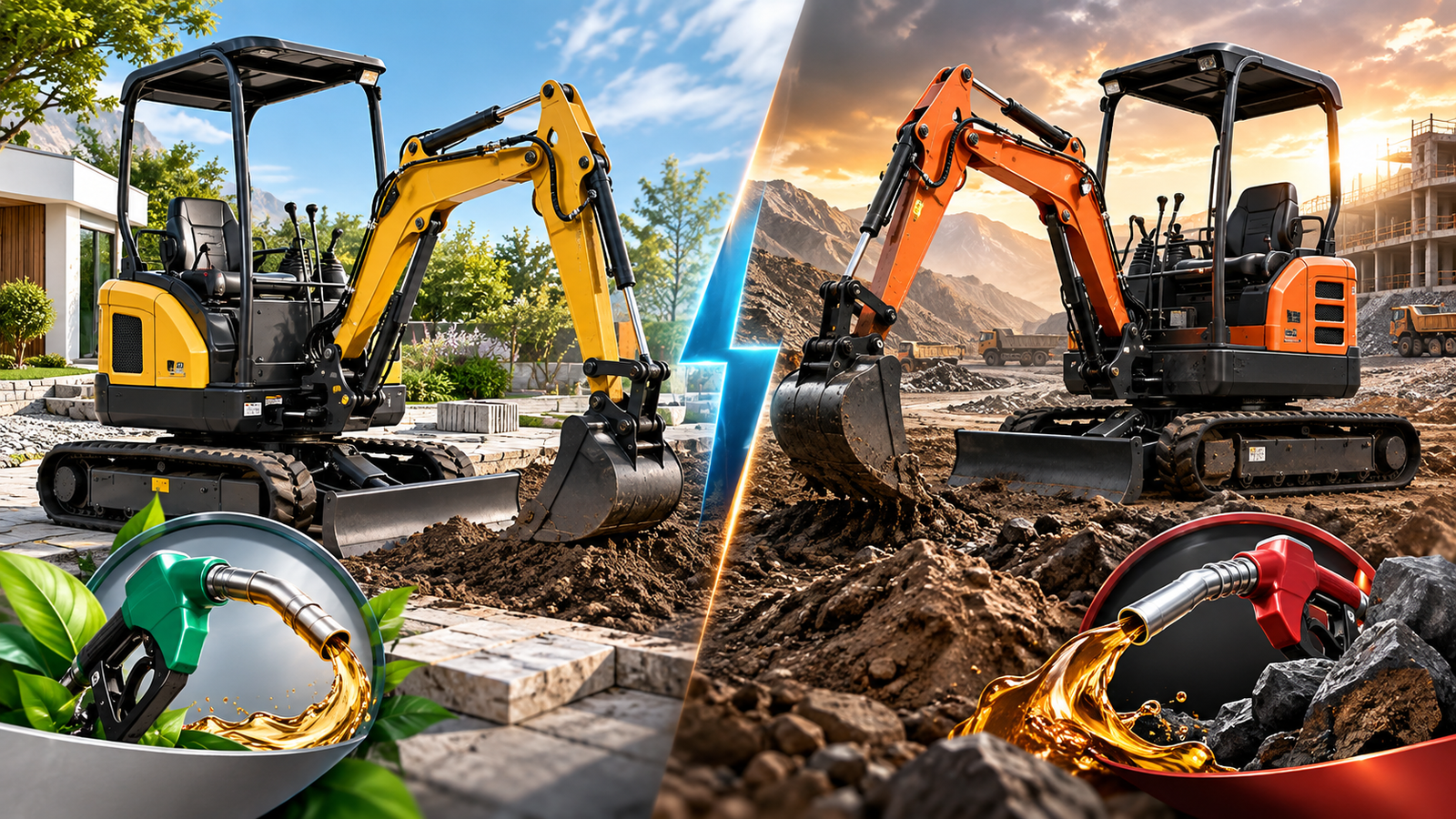
- Excellent Fuel Consumption: Mini excavators come with efficient, low-power diesel engines or eco-compliant engines that use a lot less fuel per hour than large industry machines.
- Maintenance Costs Reduced: Compact machinery features less complicated hydraulic lines, smaller track assemblies, and easier access to engine compartments that reduce the costs of mechanical servicing.
- Lower Premiums: Miniature machines’ insurance premiums are a fraction of those of full-size commercial machines.
Operational Advantages: Maximizing Job Site Efficiency
The value of an asset is solely based on how well it performs on the ground. Where giant excavators simply fail, mini excavators mark up their point with great mobility and flexibility to maneuver the space which mean faster project completion.
| Operational Feature | On-Site Performance Benefit |
| Ultra-Compact Footprint | The mini excavator can be exactly maneuvered close to existing walls and structures without accidental contact. |
| Low Structural Weight | The ground pressure of a mini excavator is very low so that it hardly causes any damage to sidewalks or lawns. |
| 360-Degree Rotation & Swing | Continuous digging and dumping in tight urban zones that restrict movement. |
Unmatched Maneuverability in Confined Spaces
- Zero Tail Swing Innovation: Most today’s mini excavators use a design with zero or at least reduced tail swing. The tail of the housing structure can turn completely within the tracks’ width without hitting walls or people besides the machine.
- Precision Control Systems: Advanced hydraulic joysticks and separate boom swings allow the operator to work accurately and even excavate very close to the foundations of the building or along the fence.
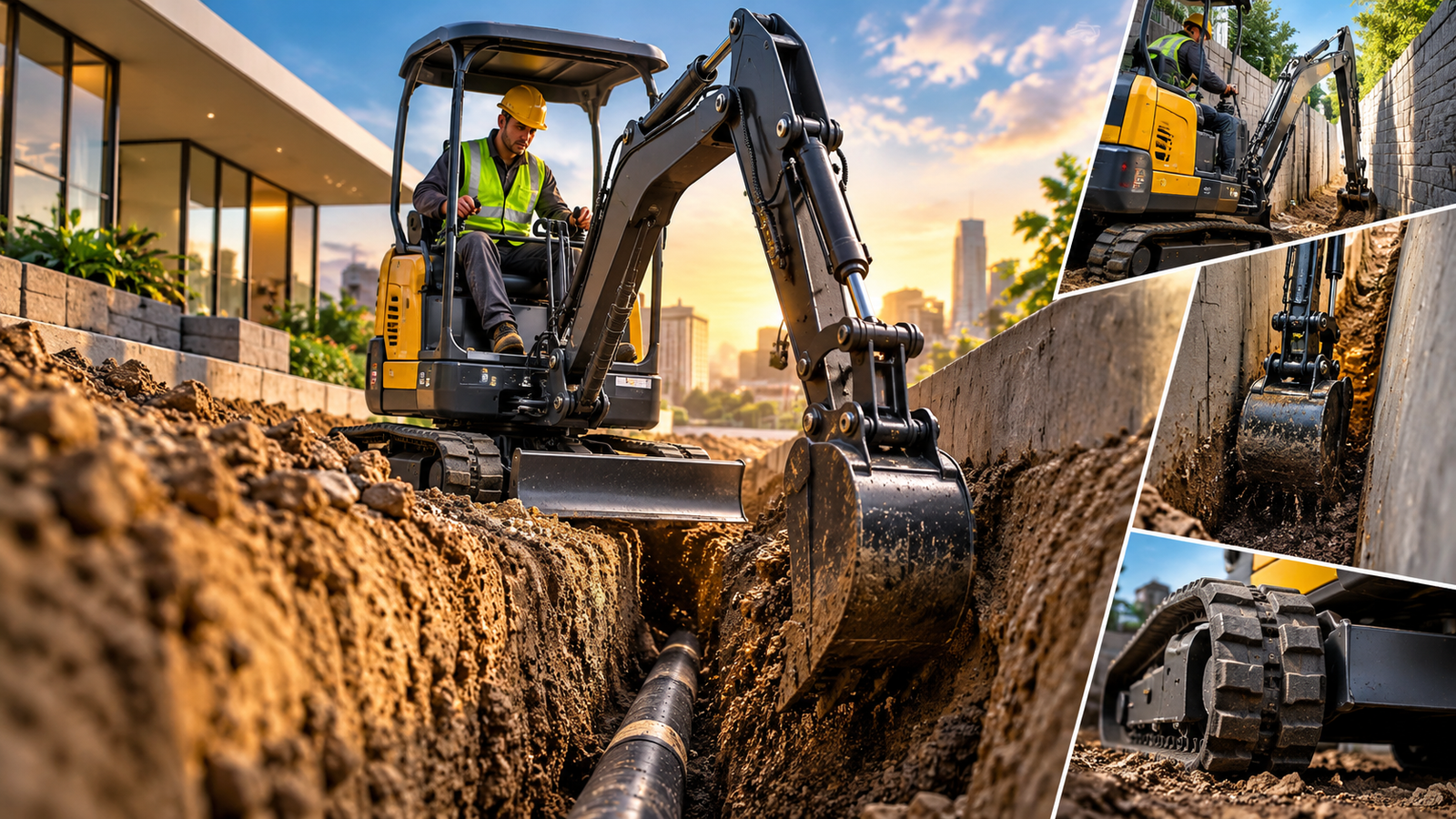
- Urban Access Capability: Since a mini excavator is very narrow, it can go through standard pedestrian garden gates, commercial doors as well as alleyways that large equipment is totally excluded from.
Low Ground Disturbance and Environmental Footprint
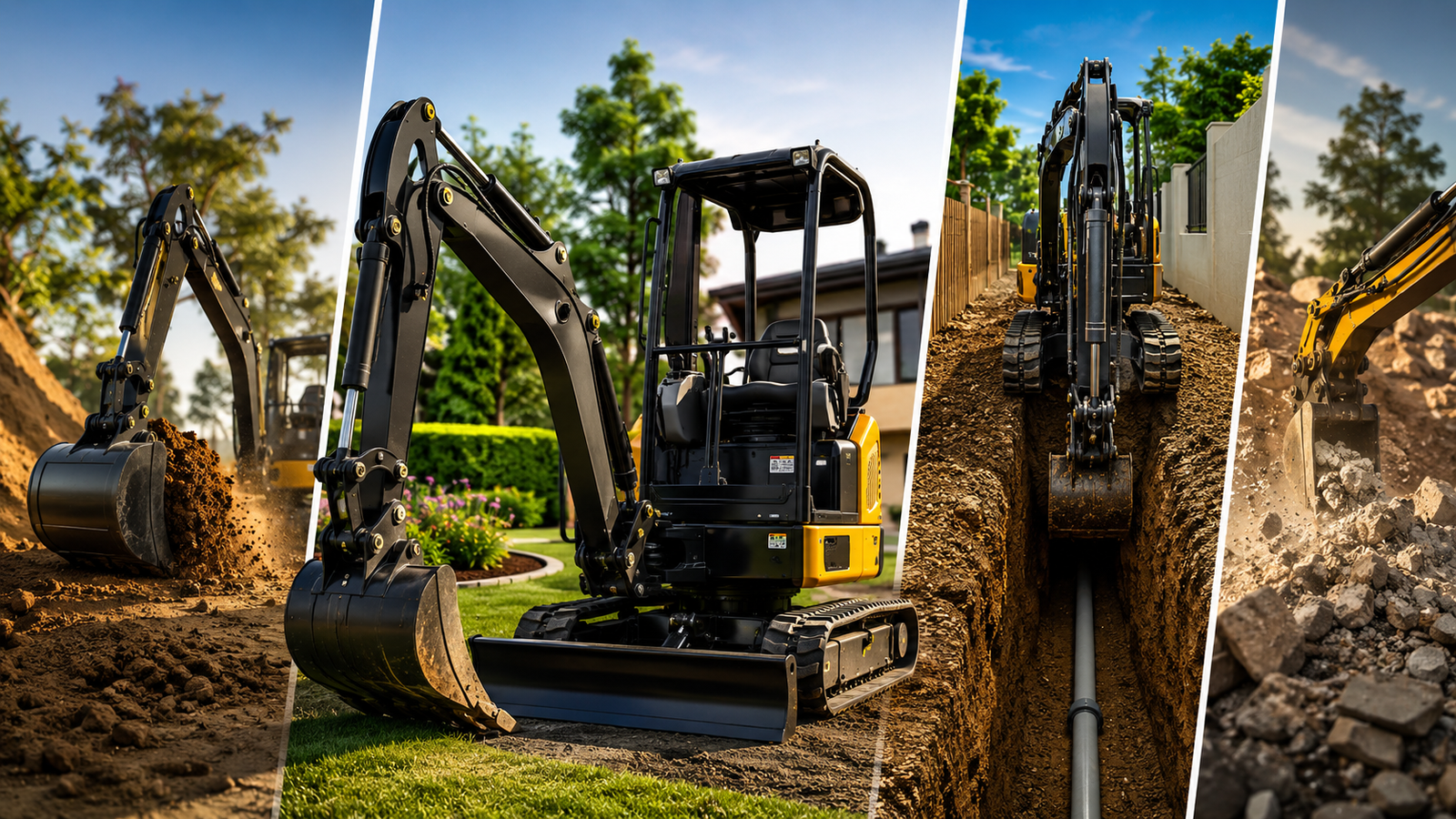
- Preservation of Finished Surfaces: Low operating weight and durable rubber tracks mean minimal exertion of pressure on the ground, thereby, sidewalks, driveways, and lawns will not be deeply gouged.
- Drastic Clean-Up Cost Reductions: Contractors end up spending far less time and monetary resources on restoring the surrounding landscape post-excavation since the machine prevents massive soil compaction and turf destruction.
- Eco-Friendly Job Execution: The modern engines in mini excavators that run with very low emission outputs and minimal noise pollution are very much suited for residential zones with strict regulations.
Multi-Functional Adaptability with Attachments
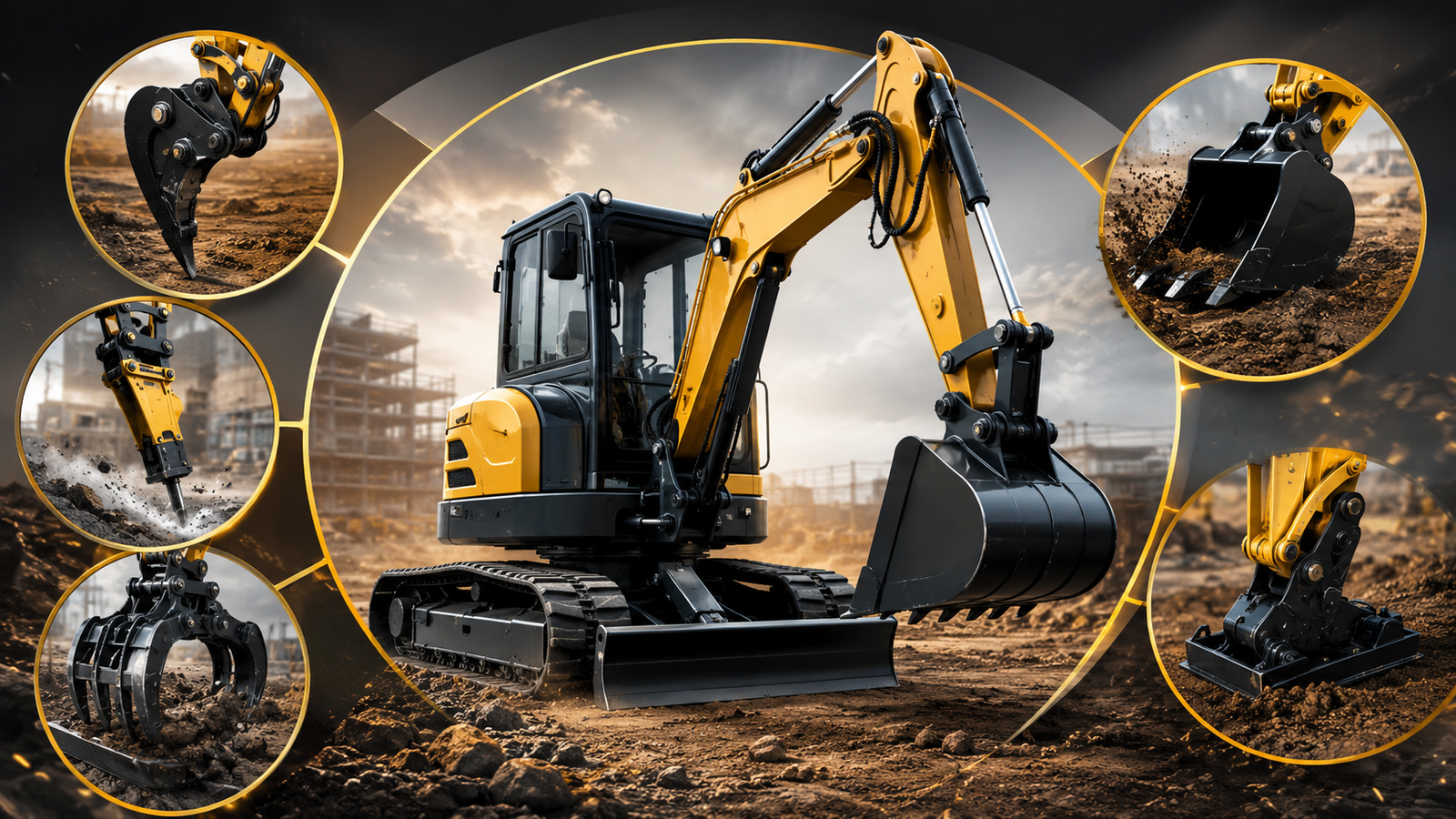
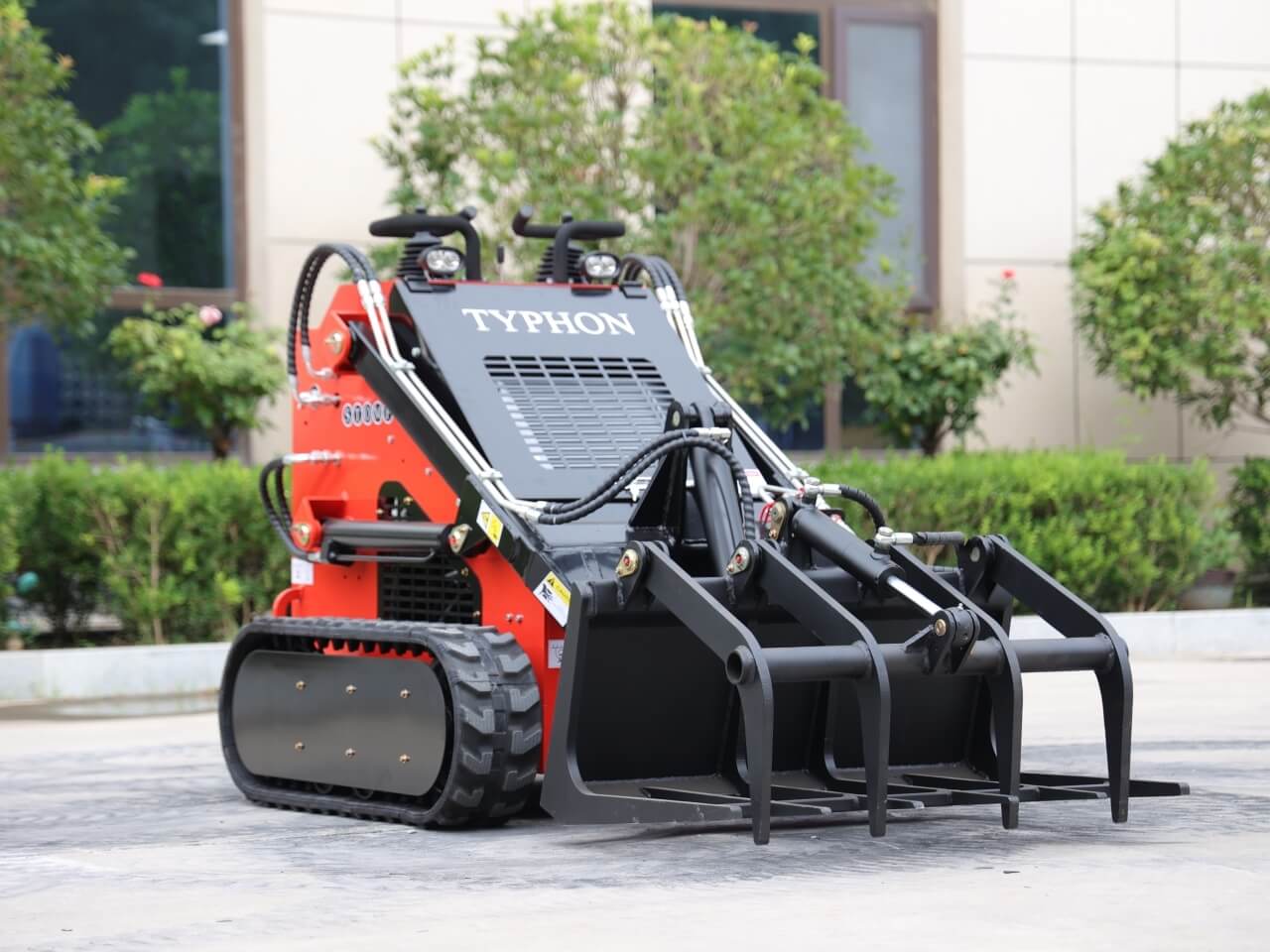
- Through comprehensive hydraulic tooling a mini excavator can be quickly changed from a standard digger into a specialized machine that supports hydraulic hammers, augers, rippers, grapples, and sorting buckets.
- Capital investments in multiple single-use machines can be avoided. A single compact unit that has been equipped with a quick-hitch system can undertake tasks of trenching, drilling, grading, and demolition.
- Workforce efficiency gets a boost. The change of attachments can happen in a few minutes which means that the machine can be engaged across various project phases and that the duration of the asset’s daily utilization is maximized.
The Core Cost-Benefit Analysis: Buying vs. Renting
Buying a mini excavator or simply renting it is basically about going through your project calendar, doing a ratio analysis of your equipment usage, and also your financial strategy for the long run. Although renting will help you avoid major immediate capital, if your projects are such that they require the equipment regularly over a long period, your profits will be eaten up quickly.
| Fleet Strategy | Long-Term Financial Implications |
| Capital Outright Purchase | You get to own the asset, have immediate job readiness, and build equity over time. |
| Short-Term Equipment Rental | On a daily basis renting costs you more money, and availability can also be an issue. |
Analyzing Asset Utilization and Break-Even Thresholds
- Work out your break-even point: Usually, the cost of renting a compact excavator for more than 30 to 40 days a year will be at least equal to if not more than the total monthly financing and maintenance cost of the equipment.
- Take advantage of the immediate use benefits: When you own the equipment, you simply get changed from making the arrangement with the rental service to delivery and such, checking their machine, and also handling shortages.
- Business assets that generate revenue over the long term: Each month you pay for financed ownership gets you business equity with a physical, high-value asset that you can resell, or use as collateral later on.
Balancing Operational Flexibility Against Risk Mitigation
- Flexible without restrictions: Your yard is always considered to be the parking spot for the machine, so it follows that anytime you want a contract to be done especially related to emergency or sudden changes to the timelines of projects, you can go ahead.
- Operational budget: Financing monthly and maintenance that is preventative means the business is well protected from sudden increases in the market rental rates.
- Assurance of total quality: When the equipment belongs to you, it will be in the hands of your staff who will be responsible for its maintenance and this way there are no chances that it will be unsafe, unreliable, or that the operator will not be able to get the maximum hydraulic efficiency.

FAQs – Is a Mini Excavator Worth the Investment?
Is a mini excavator good investment?
Mini excavators are a top-notch investment for contractors, landscapers, and utility service providers who are handling operations that fall within the range of small to medium. Some of the reasons for a fast return on investment include their very low cost, very good fuel consumption, very easy to transport, and of course, their capability to work in urban locations that are very restricted. Their costs get recovered when manual labor costs are reduced and project completion times are shortened.
How many hours will a mini excavator last?
If regularly looked after and maintained, it will last you a minimum of 5000 hours and a maximum of 10,000 hours of work. When a mini excavator is going to continuously be a very productive machine for a period of more than a decade each time the hydraulic fluids are changed, the track assembly is kept clean, and the diesel engine is serviced, this time is effectively extended.
What is the most reliable brand of mini excavator?
Many of the manufacturers like Kubota, Caterpillar, JCB, and Yanmar have the reputation of manufacturing highly reliable mini excavators. Very tough models, made with the best quality components (Kubota engines) by brands like Machinery Asia are what cater to most customers worldwide since these engines require minimal maintenance and have a long lifespan.
What are the disadvantages of a mini excavator?
A mini excavator gives you the freedom to work, and then when it cannot handle the job, the disadvantages will become apparent. If anything else, small lifting capacities, limited digging depths, and fewer speeds while driving are the few traits of mini excavators when compared to the big chain crawler excavators. In their scenario, the lighter weight of these machines also limits their stability on uneven, or muddy or extremely rugged off-road terrains. Apart from these, big earthmoving, deep quarry mining, or breaking heavy layers of rock are the type of work that they are not built for.
Is it better to rent or buy a mini excavator?
When it comes to picking one of the options between renting and buying, you are really basing your decision on how often the machine will be used. Occasional use, scattered projects throughout the year is the scenario for which renting is given as a recommendation as it saves the upfront capital costs. On the other hand, if the operation vessel is such that it keeps on using the machine for more than 30 to 40 days annually, purchase becomes by far the more lucrative option and over a period of time it leads to savings and is also building the business equity in the long run.
What size mini excavator is the most versatile?
The 2.5 to 3.5-ton range is generally considered to be the most versatile mini excavator size for general contracting work. In fact, the balance that this weight segment has struck between compact agility and high hydraulic power is perfect. When it comes to breakout force, it is enough to handle challenging trenching as well as demolition work and at the same time, it is light enough for transport on a standard utility trailer without the need for permits that are specialized for transport.
Conclusion: Maximizing Profits with Compact Machinery
This mini excavator cost-benefit analysis was exhaustive and showed that a mini excavator is a very profitable investment for those with modern construction, utility, or landscaping fleets. With its combination of small upfront price, cheap maintenance, minimal fuel consumption, and excellent maneuvering in the urban environment, the mini excavator is a practical powerhouse for the small to medium scale projects.
By making the risks of manual labor shortages nearly nonexistent and also accelerating project timelines, these machines actually create the competitive advantage. When it comes time to ramp up your fleet capabilities, you will first need to partner with a reputable and established equipment provider.
Machinery Asia is continuously updating its extensive equipment offerings and is proud to present a great collection of mini-excavators. Their engines are highly regarded worldwide and are combined with very durable hydraulic systems that can withstand working in harsh environments.
Purchasing from their recent mini excavator lineup is guaranteed to meet your venture’s operational efficiency needs, as well as project execution reliability. And you will get a great return on investment for many years to follow.