Top 5 Essential Mini Excavator Attachments to Maximize Your Work Versatility
Let’s be honest: when you buy a piece of heavy equipment from TYPHON Machinery, you expect it to do a lot of heavy lifting. But the real secret to getting the absolute most out of your machine isn’t just about the horsepower—it’s about what you put on the end of the stick.
Getting the Most Out of Your 1-Ton Excavator Machine
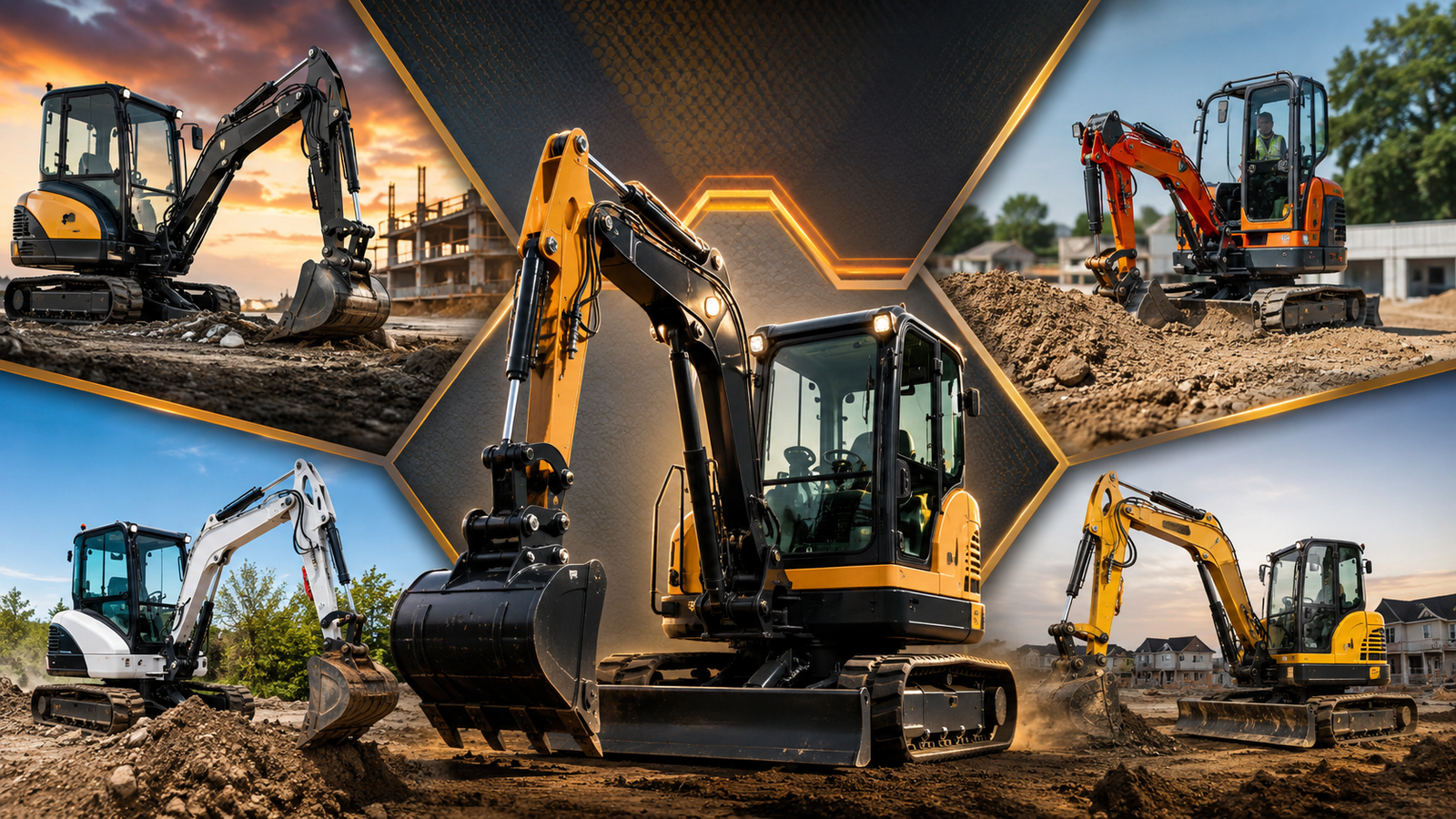
The standard digging bucket is great for basic dirt work, but today’s job sites demand a lot more flexibility. Whether you are running the compact 1-ton TYPHON TERROR X STORM in a tight backyard or operating the enclosed, climate-controlled 2-ton TERROR XVIII on a larger site, the right mini excavator attachments will completely change how you work.
Instead of hauling three different machines to a site, you can just swap out the tool on your excavator’s boom. You can jump from trenching to breaking concrete, and then clear out heavy brush, all before lunch.
Before we get into the specific tools that will make your life easier, let’s look at why building an arsenal of quality attachments is such a smart move for your bottom line:
- Keeps more money in your pocket: Buying one solid base machine and a few different attachments is way cheaper than renting or buying dedicated machines for every single odd job.
- Frees up site space: If you’re working in a cramped residential neighborhood or a busy city lot, using versatile mini excavator attachments on one footprint keeps your site from turning into a parking lot.
- Gets the job done faster: When a single operator can quickly switch tools and tackle different phases of a job back-to-back, your daily productivity shoots through the roof.
Landscaping to Trenching – Top 5 Mini Excavator Attachments for 1-Ton Excavator
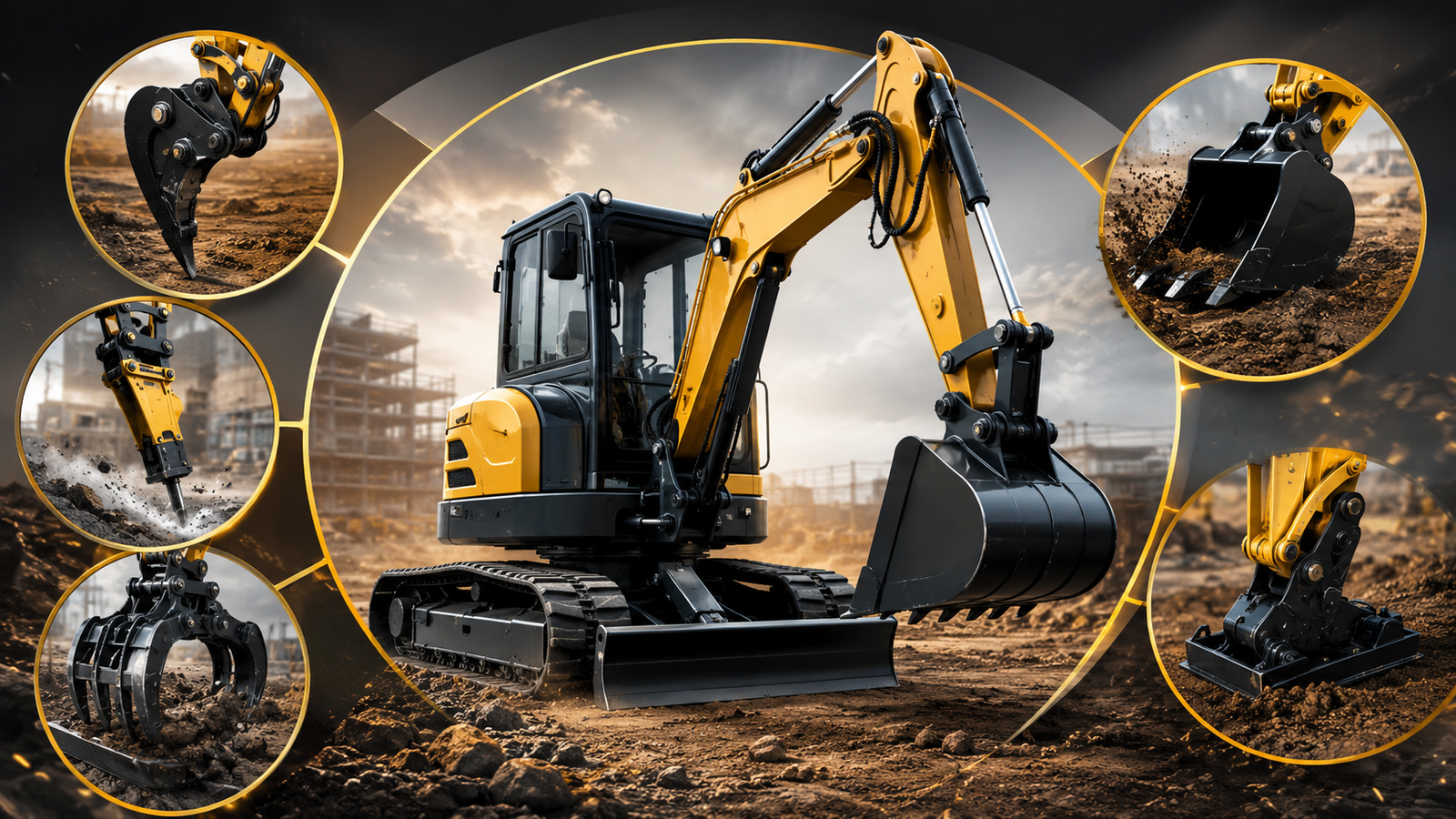
1. Hydraulic Breakers: Making Demolition Painless
Anyone who has spent a summer afternoon wrestling with a manual jackhammer knows exactly how exhausting concrete demolition can be. Tying a hydraulic breaker (also known as a hydraulic hammer) into your fleet of mini excavator attachments takes all that physical strain out of the equation.
This tool taps into the pressurized hydraulic fluid of your TYPHON excavator to deliver fast, heavy blows to concrete, asphalt, or solid rock. Because TYPHON machines use reliable, EPA-certified engines, they deliver the steady hydraulic flow needed to run these breakers without constantly overheating.
You can sit comfortably in the cab of your TERROR XVIII and bust up an old driveway in a fraction of the time it would take a whole crew working by hand.
To keep your hydraulic breaker hitting hard and lasting a long time, keep these field tips in mind:
- Keep it straight: You always want to hit the concrete at a perfect 90-degree angle. If you hit it at a weird angle, the tool can slip, which risks bending the bit or straining your boom.
- Stop prying: It’s super tempting to use the breaker bit as a crowbar to rip chunks of concrete out, but this is the number one way to snap a bit and land yourself a heavy repair bill.
- Give it a rest: Only run the breaker in short bursts of about 15 to 30 seconds. Pounding non-stop heats up your hydraulic oil really fast and wears out the internal seals.
2. Earth Augers: Digging Perfect Holes Every Time
If your upcoming schedule is packed with putting up fences, planting trees, or setting deep concrete footings, you need an earth auger. Trying to dig a narrow, deep hole with a standard bucket usually leaves you with a massive crater that you just have to backfill and tamp down again.
It ruins the ground stability. An auger drive mounts to your boom and spins a massive drill bit right into the dirt, pulling out the soil and leaving a perfect, clean cylinder behind. For landscapers and agricultural workers running TYPHON equipment, auger mini excavator attachments save days of miserable manual labor.
Plus, you can swap out the bits depending on the ground—standard bits for topsoil, and rock-drill heads for chewing through hard clay or stony ground. When you’re running an auger on the job, make sure you follow these best practices:
- Match the teeth to the dirt: Don’t ruin a standard dirt bit on rocky ground. Take the time to swap to heavy-duty rock teeth if you know you’re going into tough soil.
- Check your angles: Before you start spinning, use the flexibility of the excavator arm to make sure the auger is hanging dead straight, especially if your tracks are sitting on a hill.
- Clear the dirt out: Don’t just drill all the way down in one shot. Pull the spinning auger up every foot or so to fling the loose dirt away, otherwise, you might get it permanently stuck in a deep hole.
3. Specialized Buckets: Picking the Right Tool for the Dirt
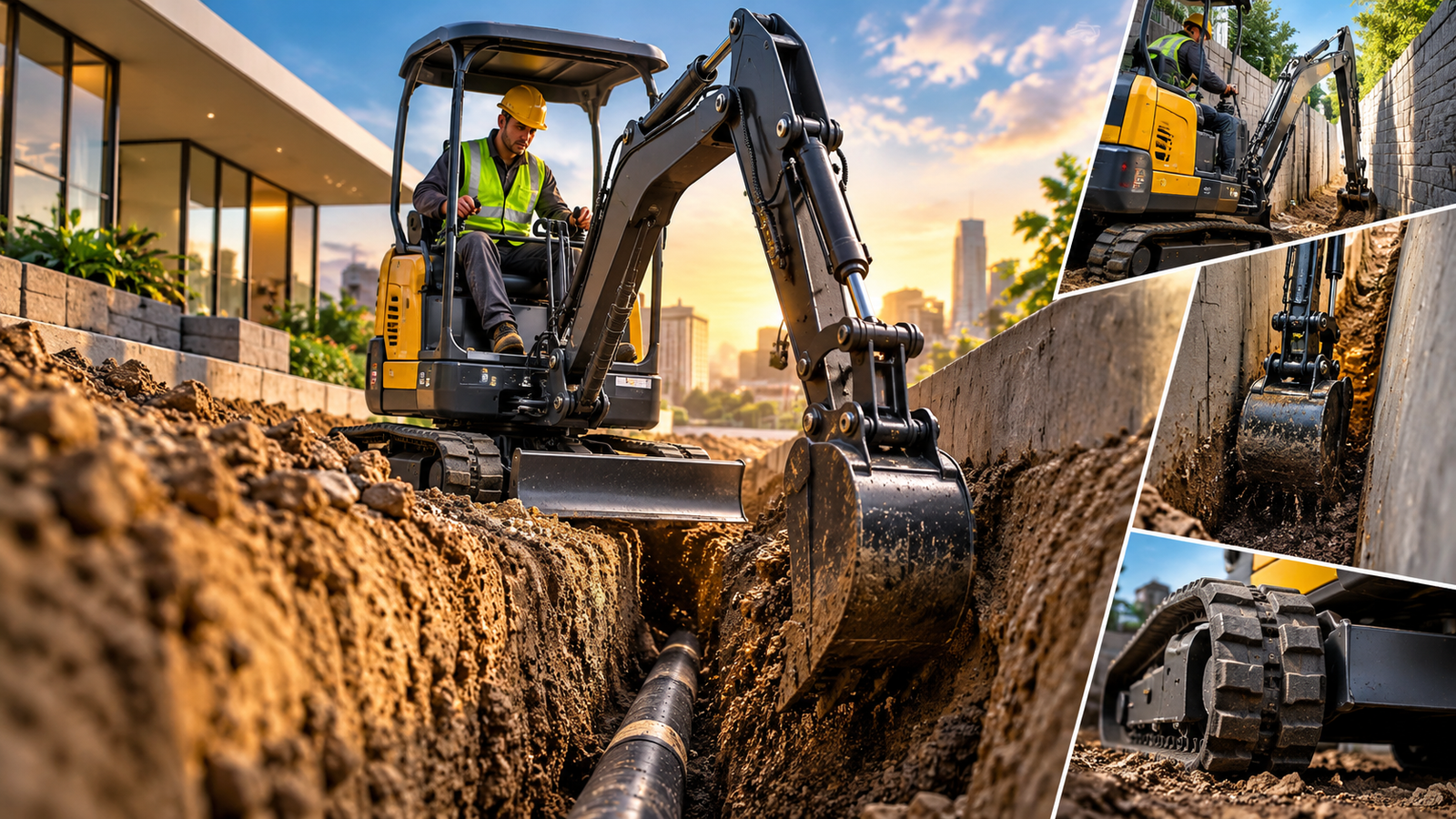
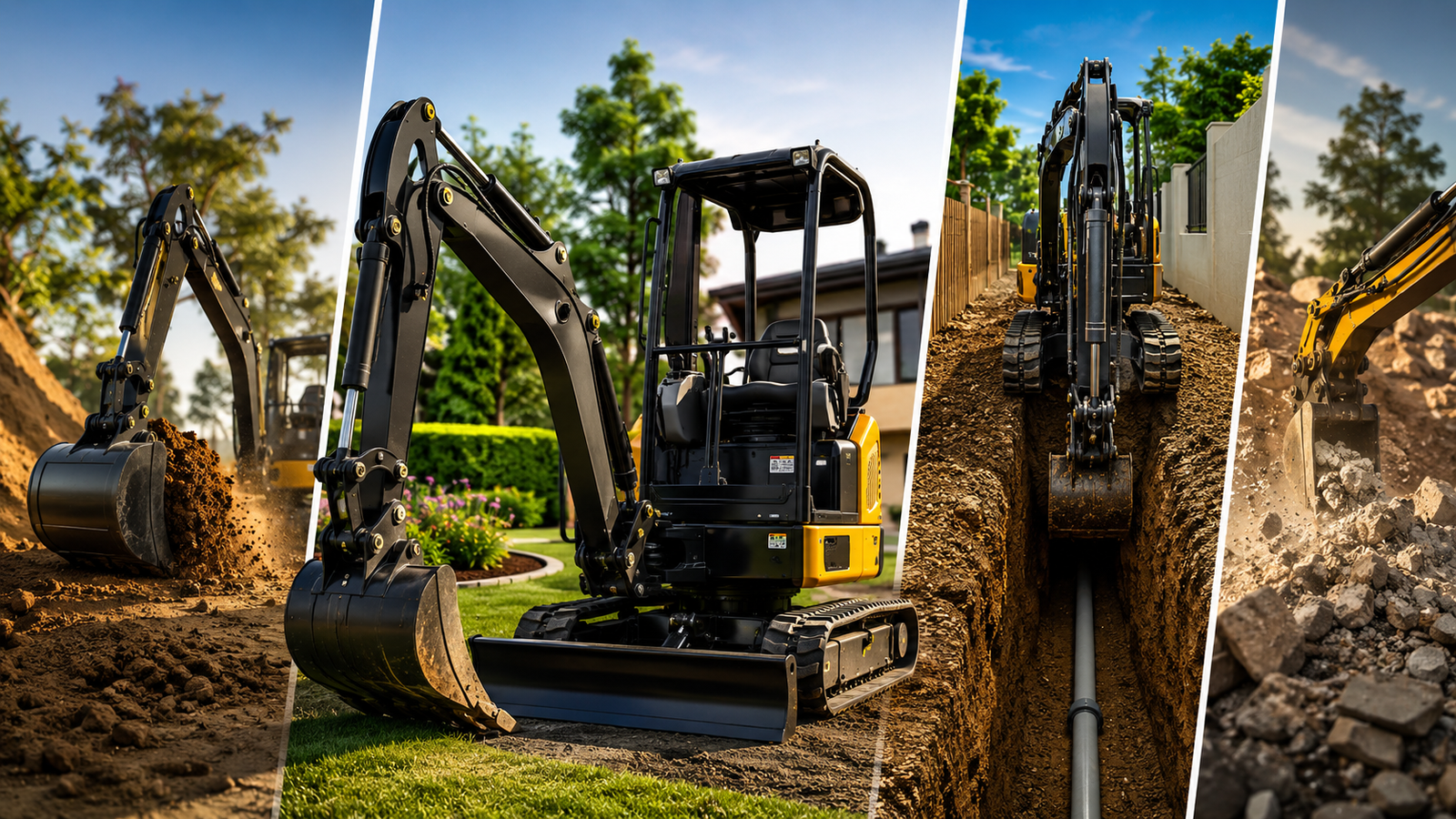
Your TYPHON machine came with a great standard bucket, but building out a collection of specialized bucket mini excavator attachments gives you pinpoint accuracy. Trenching buckets, for example, are tall and skinny.
They are built exactly for dropping in water pipes, electrical lines, or fiber optics without moving an ounce of dirt more than you have to. On the flip side, you have grading buckets (or ditching buckets).
These are wide, have a smooth edge with no teeth, and are made for finishing work. You use them to scrape topsoil smooth, backfill your trenches, or shape a yard so water drains away from a house. Some grading buckets even tilt side-to-side hydraulically, which is amazing for cutting angled ditches while the machine stays flat.
Knowing which bucket to grab will save you hours of cleanup work later:
- Teeth for digging, smooth for finishing: Only use your toothed buckets when you actually need to break through packed dirt; use your wide, smooth buckets when you want the ground to look nice afterward.
- Keep trenches tight: Always pick a trenching bucket that’s just barely wider than the pipe you are laying. Digging a massive trench just wastes your time digging and wastes your time backfilling.
- Watch your weight: A massive grading bucket full of wet, sloppy mud is incredibly heavy. Be careful when swinging it around so you don’t throw your 1-ton machine off balance.
4. Hydraulic Thumbs: Grabbing the Un-Grabbable
Standard buckets are awesome at moving loose dirt, but they are absolutely terrible at picking up anything weirdly shaped. Trying to balance a tree stump or a jagged chunk of concrete on bucket teeth is a nightmare.
Adding a hydraulic thumb to your mini excavator attachments changes the game. It’s essentially a heavy steel clamp that folds down against the bucket, gripping things just like your thumb grips your fingers. Pinning a thumb onto a TYPHON TERROR ONE STORM turns it from a simple digger into a full-on material handler.
You can pinch heavy logs, rip tangled roots out of the ground, and easily sort through demolition scrap. To handle materials safely without damaging your machine, stick to these rules:
- Find the balance point: Always try to grab long things, like poles or tree trunks, right in the middle so the weight doesn’t seesaw and throw your machine off balance.
- Keep it low: Just because the thumb has the grip strength to hold something doesn’t mean your machine has the stability to swing it around high in the air. Keep heavy stuff low to the ground.
- Tuck it away: When you are done grabbing and need to go back to digging a trench, make sure the thumb is completely folded back and locked, otherwise it will scrape against the trench walls.
5. Rippers: Tearing Through the Tough Stuff
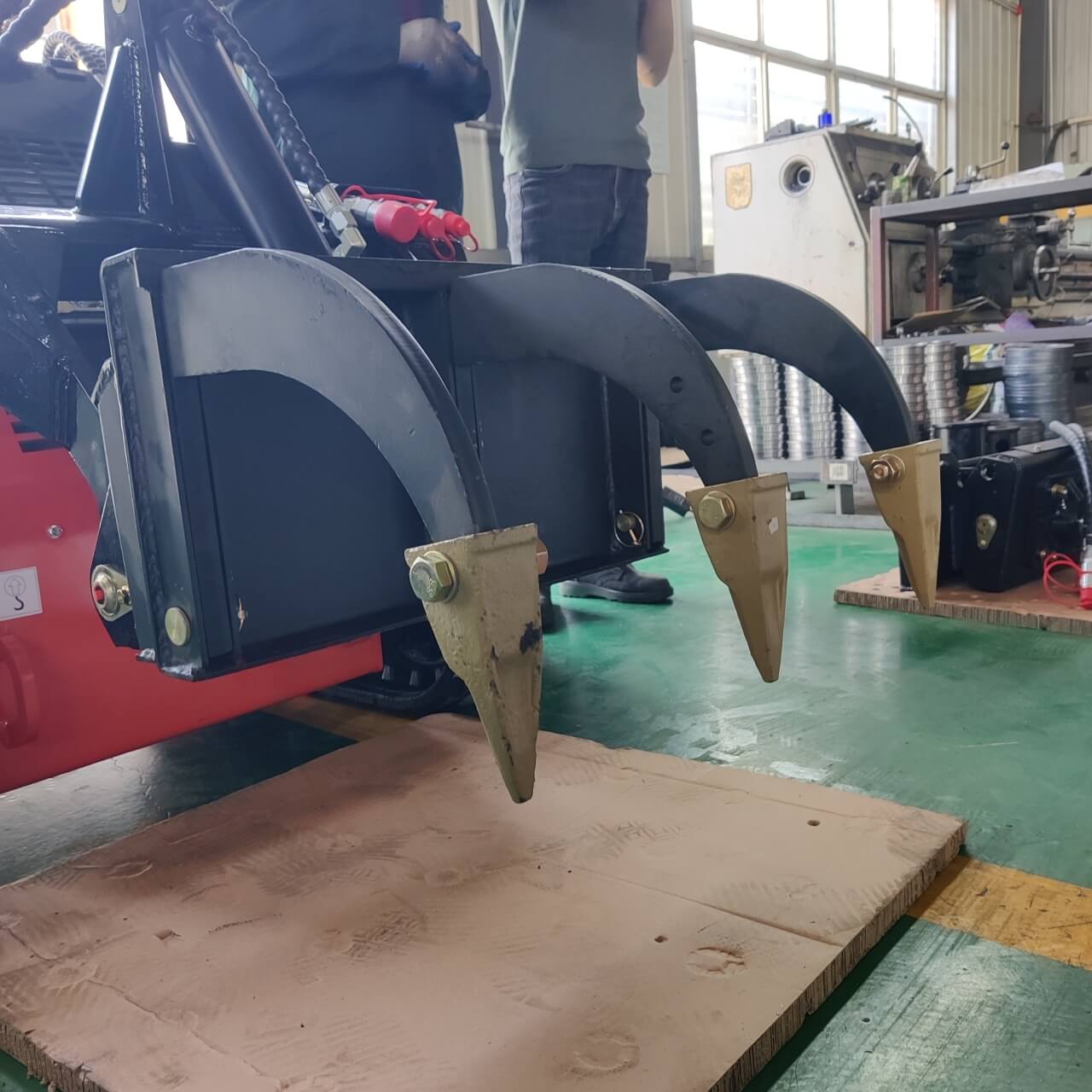
Sometimes you hit ground that is just too hard for bucket teeth to scratch. If you’re dealing with deep winter frost, baked clay, or a massive network of thick tree roots, a ripper is exactly what you need.
Out of all the mini excavator attachments out there, rippers are arguably the toughest. It’s basically a massive, hook-shaped claw made of thick steel that concentrates the entire pulling force of your TYPHON machine onto one single, sharp point.
You drag it through the hardpan to fracture the earth, which loosens everything up so you can easily scoop it away with a bucket. They are also incredible for ripping out old asphalt driveways without beating up your machine’s hydraulic system. When you bring a ripper to a tough job site, use these techniques to get the most out of it:
- Use the wrist action: Don’t just drag the whole boom backward. Plant the ripper and use the curl of the bucket cylinder to aggressively hook and pull through the hard ground.
- Cross-hatch the ground: If you have a big area of hard clay, drag the ripper in a grid pattern (north-to-south, then east-to-west) to shatter the ground completely before you try to bucket it out.
- Watch the tooth: Keep a close eye on the replaceable tip of the ripper. If you wear that tip down to nothing, you’ll start grinding away the expensive main steel shank.
Bonus: The Game-Changing Quick Coupler
Having a yard full of mini excavator attachments is great, but spending twenty minutes beating out steel pins with a sledgehammer every time you want to switch tools gets old really fast.
A quick coupler (or quick hitch) fixes this completely. It mounts to the end of your boom and uses a locking system to grab your tools. With a quick coupler, you can drop your digging bucket and hook up your hydraulic breaker in literally a minute or two, often without ever stepping out of the cab.
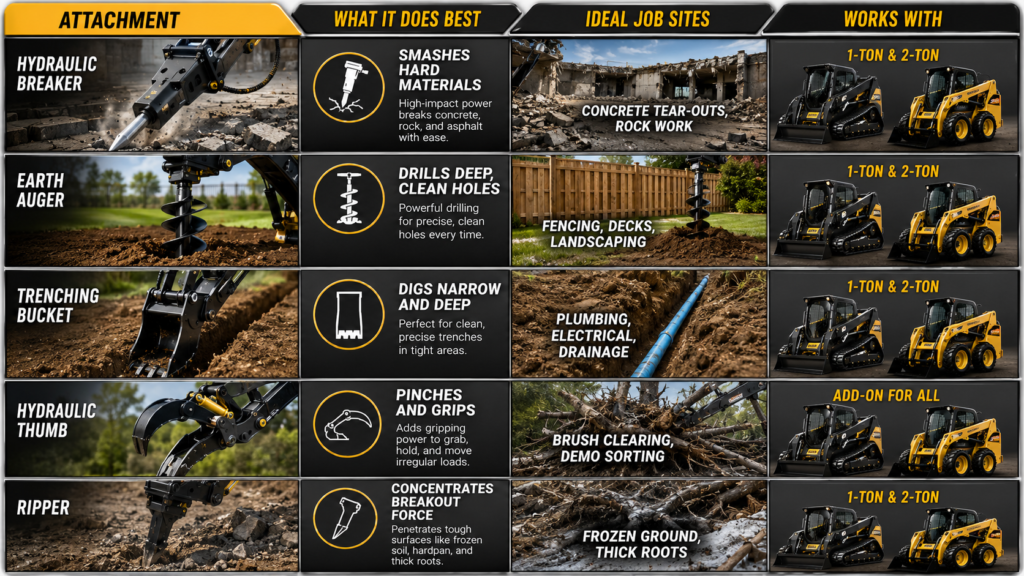
Table: Mini Excavator Attachments
To give you a quick cheat sheet on what goes where, here’s a breakdown of how these tools fit into your daily grind:
| Tool Name | What It Does Best | Ideal Job Sites | Works With TYPHON |
| Hydraulic Breaker | Smashes hard materials | Concrete tear-outs, rock work | 1-Ton & 2-Ton |
| Earth Auger | Drills deep, clean holes | Fencing, decks, landscaping | 1-Ton & 2-Ton |
| Trenching Bucket | Digs narrow and deep | Plumbing, electrical, drainage | 1-Ton & 2-Ton |
| Hydraulic Thumb | Pinches and grips | Brush clearing, demo sorting | Add-on for all |
| Ripper | Concentrates breakout force | Frozen ground, thick roots | 1-Ton & 2-Ton |
If you are thinking about adding a quick coupler, remember these few things:
- Measure twice: Make absolutely sure the coupler you buy matches the pin sizes and the spacing of all the attachments you already own.
- Double-check the lock: Always give the tool a little shake near the ground to verify the safety lock is fully engaged before you lift it high in the air.
- Account for the weight: A quick coupler is essentially a heavy block of steel permanently sitting on the end of your arm, which will slightly lower the maximum weight your machine can lift.
FAQs About 1-Ton Mini Excavator Attachments
What are the most useful mini excavator attachments?
For most guys out there, the standard digging bucket, a hydraulic breaker, and an earth auger are the holy trinity of mini excavator attachments. Buckets do the heavy moving, while breakers and augers let you handle the demo and foundational work that almost every job requires.
Are mini excavator attachments universal across different brands?
No, you can’t just slap any tool on any machine. It all comes down to the size of your boom’s pins, the distance between them, and the width of the arm itself. Powered tools also have to match the hydraulic pressure your specific machine puts out.
How do I choose the right attachment for my TYPHON mini excavator?
Start by looking at the work you actually do most days. Then, check the lifting capacity and hydraulic output in your TYPHON manual. Finally, talk to the guys at Machinery Asia—they can tell you exactly what fits your specific quick hitch or pin setup so you don’t waste your money.
Can I use a hydraulic breaker on a 1-ton mini excavator?
You sure can! The TYPHON 1-ton TERROR X STORM handles a scaled-down breaker with no problem. You just have to make sure you buy a breaker rated specifically for a 1-ton unit so you don’t overwhelm your hydraulic pump.
What is the difference between a pin-on attachment and a quick coupler?
Pin-on means you have to physically line up holes and hammer thick steel pins through them to lock the tool in place. A quick coupler is a bracket that stays on your machine and uses hooks and locks to grab the tool, making changes incredibly fast.
How do I maintain my mini excavator attachments to ensure longevity?
It’s mostly just common sense. Pump grease into every fitting daily, check your rubber hoses for cuts, swap out dull bucket teeth before they ruin the bucket itself, and try to store them on a wooden pallet instead of sinking in the dirt.
Do attachments affect the lifting capacity and stability of the machine?
Absolutely. An attachment is dead weight at the end of your boom. Heavy mini excavator attachments will cut down how much extra dirt or material you can safely pick up. Always keep your dozer blade down and tracks widened (if you have that feature) to keep yourself planted.